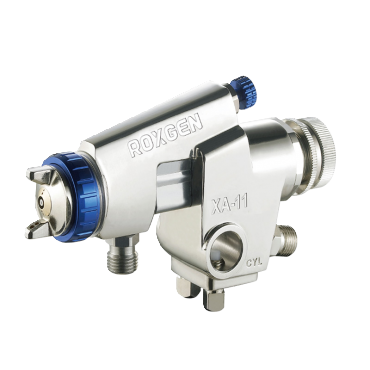
How do automatic spray guns improve the quality and consistency of finishes in the automotive industry?
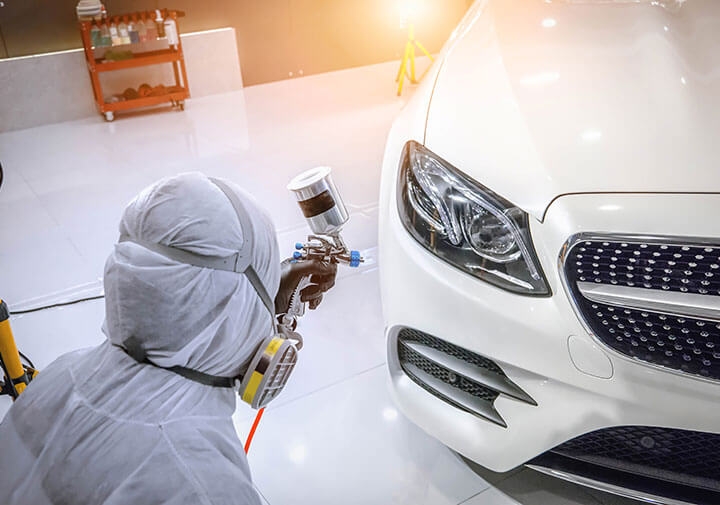

In the automotive industry, automatic spray guns play a crucial role in improving both the quality and consistency of surface finishes. Compared to traditional manual spraying, automated systems significantly reduce human error and ensure that every vehicle meets the same high aesthetic and performance standards.
One of the key advantages of automatic spray guns is their precise control, managed through computer programming. Factors such as spray angle, distance, movement speed, and pressure can be fine-tuned, resulting in an even and uniform coating on all vehicle surfaces. This helps eliminate common issues seen in manual spraying, such as color inconsistencies, sagging, or uneven film thickness, ultimately enhancing the overall finish quality.
Moreover, advanced automatic spray guns deliver superior atomization, breaking the paint into ultra-fine aerosol particles. This not only improves the adhesion of the paint to the metal surface but also contributes to a smoother, glossier, and more refined appearance. At the same time, it enhances the coating’s durability and resistance to corrosion, weathering, and UV exposure.
In large-scale automotive production lines, automatic spray guns are often integrated with robotic arms to perform highly repeatable and precise spraying tasks. They can easily navigate complex curves and reach difficult areas, ensuring complete and accurate coverage. Automated systems also help reduce material waste and VOC (Volatile Organic Compound) emissions, making the process more environmentally friendly and cost-effective.
By combining precision technology with operational efficiency, automatic spray guns have become an essential component of modern automotive manufacturing. They not only ensure consistent, high-quality finishes but also streamline production and reduce labor costs. Choosing automatic spray technology reflects a commitment to excellence in both product quality and manufacturing performance.